Mastering ACT Science & Math: 2026 Photo-Based Solving Guide
As ACT standards evolve in 2026, mastering the 'Scan and Study' methodology is essential for high-scoring students balancing Science and Math pressures.
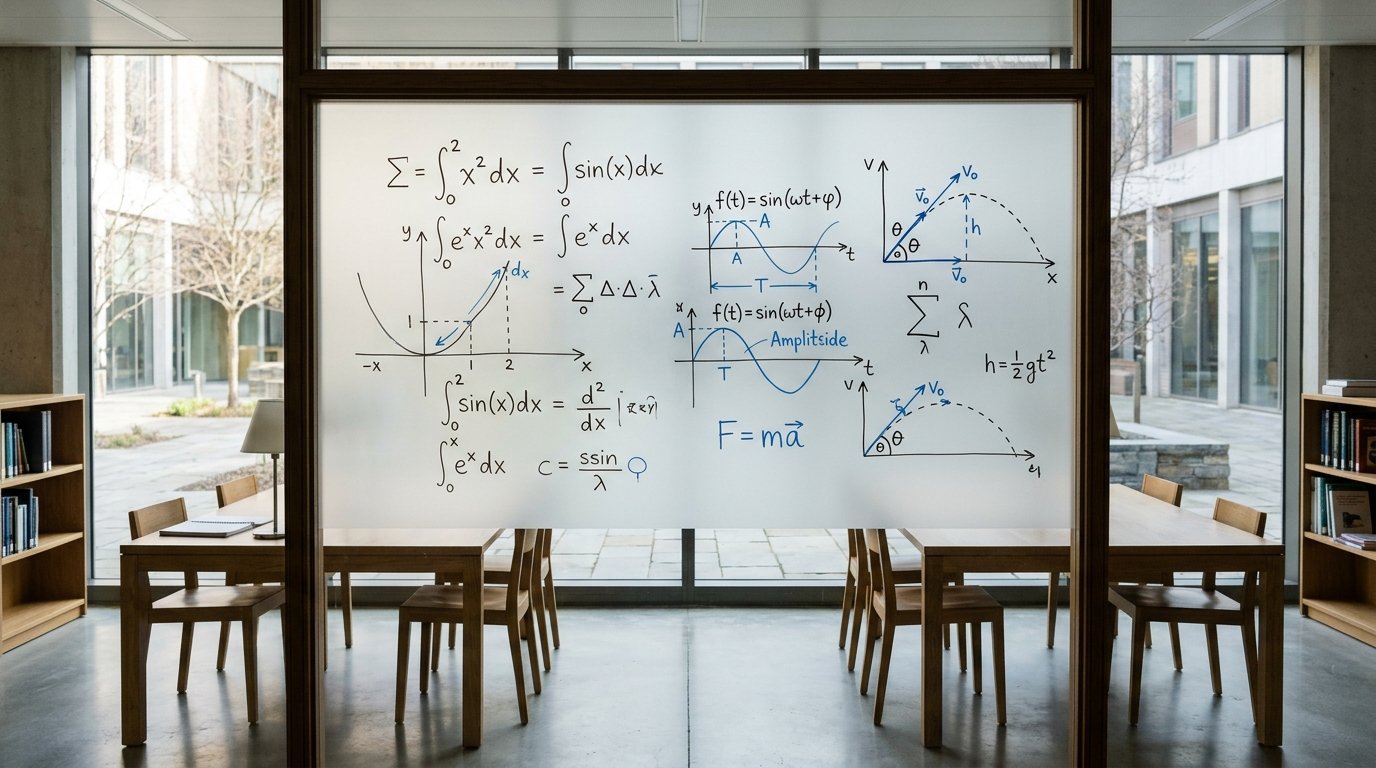
The 2026 ACT Challenge: Why Static Study Isn't Enough
The academic landscape of 2026 has shifted. With the ACT increasingly focusing on complex data synthesis and higher-level Algebra II/Trigonometry integration, students are finding that traditional paper-and-pencil methods often lead to burnout. The primary pain point isn't just knowing the formulas—it's the speed of recognition. Whether you are navigating the Arizona ESA homeschooling path or a traditional high school track, the ability to transition from a confusing practice problem to a clear, conceptual breakdown is the difference between a 24 and a 34.
**Key takeaway:** Success in the 2026 ACT requires moving beyond rote memorization to a workflow where you can instantly analyze complex diagrams and data sets using high-precision OCR technology.
Solving ACT Math Problems from a Picture
One of the most effective ways to bridge the gap between confusion and mastery is the "visual-to-proof" workflow. When you encounter a complex geometry problem or a multi-step algebraic equation, the manual process of re-typing the equation into a calculator often leads to syntax errors.
By learning [how to solve math problems from a photo: step-by-step AI guide](/blog/solve-math-problems-from-photo-ai-guide), you can bypass the data entry phase and jump straight into the logic. On the ACT, this is particularly useful for the middle 20 questions (31-50), which often involve coordinate geometry or complex probability. Using [AI HomeTutor](/) and its QuickSnap OCR, you can capture a screen region of a practice test and immediately see the underlying geometric proof.
Step-by-Step Example: The Circle Equation Trap
The Problem: A circle in the $xy$-plane has center $(h, k)$ and radius $r$. If the equation of the circle is $x^2 + y^2 - 8x + 10y + 5 = 0$, what is the value of $r$?
1. Identify the Standard Form: You must convert the general form to $(x - h)^2 + (y - k)^2 = r^2$.
2. Complete the Square: Group the $x$ terms and $y$ terms: $(x^2 - 8x) + (y^2 + 10y) = -5$.
3. Add Constants: $(x^2 - 8x + 16) + (y^2 + 10y + 25) = -5 + 16 + 25$.
4. Simplify: $(x - 4)^2 + (y + 5)^2 = 36$.
5. Solve for $r$: $r^2 = 36$, so $r = 6$.
While this looks simple on paper, under the 60-minute time crunch, many students forget to add the constants to both sides. Using the Detailed Proof Mode on the [AI HomeTutor Chrome Extension](/#extension) ensures that every step of the "completing the square" process is visualized, helping you internalize the pattern for the real exam.
ACT Science: Conquering Data Interpretation
The 2026 ACT Science section has moved away from "science knowledge" and toward pure "data literacy." You are essentially being tested on your ability to read graphs under extreme pressure.
When dealing with the "Conflicting Viewpoints" passage, use the Live Web Search Grounding feature of the [AI HomeTutor Pricing](/pricing) Ultra plan. This allows you to cross-reference the scientific theories mentioned (like Martian atmospheric composition or tectonic shift theories) to gain a deeper context that makes the passage logic feel intuitive rather than abstract.
Common ACT Exam Traps & How to Avoid Them
Even the brightest students fall for these specific 2026 traps. To stay ahead, use [multiple choice math test strategies: beat traps & solve faster](/blog/multiple-choice-math-test-strategies-beat-traps) to refine your approach.
• **The "Outside Knowledge" Trap (Science):** Don't bring your own science knowledge into the answer. The ACT Science section is a closed-loop system. If the graph says water boils at 90 degrees on a fictional planet, that is the "truth" for that question.
• **The "Unit Mismatch" Trap (Math):** A question might give dimensions in inches but ask for the area in square feet. Always check your units before selecting an answer.
• **The "Red Herring" Variable:** Especially in the 2026 ACT, questions often provide three variables but only require two to solve. If you find yourself using every number provided, stop and re-read the specific question prompt.
Optimizing Your 2026 Study Workflow
To maximize your score in the final 30 days before the exam, you need to switch between different AI models depending on the subject. For Math, GPT-5.4 remains the gold standard for logical proofs. For Science passages that require rapid reading and synthesis, Claude Sonnet 5.5 or Gemini 4 Flash offer superior context windows and nuance.
With AI HomeTutor, you can route your own personal API keys directly through the extension, allowing you to use these flagship models right on top of your digital practice tests (Canvas, McGraw Hill, or PDF viewers). If you are on the Free tier, you still get 20 monthly solves powered by Tutor Vision 4, which is specifically tuned for academic OCR. For those aiming for a top-tier university mission, upgrading to the Pro or Ultra Student Pass provides the speed and volume (up to 800 solves/mo) needed for intensive cram sessions.
Related Study Guides & Next Steps
• **Related Study Guide:** [Mastering Geometry Proofs: 5 Steps to Ace Logic-Heavy Math Exams](/blog/mastering-geometry-proofs-ace-math-exams)
Frequently Asked Questions
Can I use AI HomeTutor for the ACT Science section?
Yes. AI HomeTutor's QuickSnap OCR can capture complex graphs and tables, helping you interpret data trends and identify conflicting scientific viewpoints instantly.
How does 'Solve Math Problem from Picture' help with ACT Math?
It allows you to instantly see a step-by-step breakdown of geometry and algebra problems you find in practice tests, helping you learn the logic rather than just getting the answer.
Which AI model is best for ACT prep in 2026?
GPT-5.4 is excellent for Math proofs, while Claude Sonnet 5.5 is highly recommended for the reading-heavy Science and English sections due to its advanced reasoning.
Does AI HomeTutor work on digital testing platforms?
Absolutely. AI HomeTutor is a Chrome and Edge extension that works on top of any website, including practice platforms like Canvas, Blackboard, and digital PDF readers.